Interaction Pipeline
Realtime Models
A realtime model is what actually conducts a conversation. It receives the rendered system
prompt and a tool box, and returns a RealtimeSession that consumes input elements and produces
realtime elements — transcripts, response text, audio, tool events and response boundaries.
Each provider is one implementation. InternalRealtimeModel is the exception: it emulates a
realtime provider by composing separate speech recognition, chat and speech synthesis components.
Model Types and What They Compose
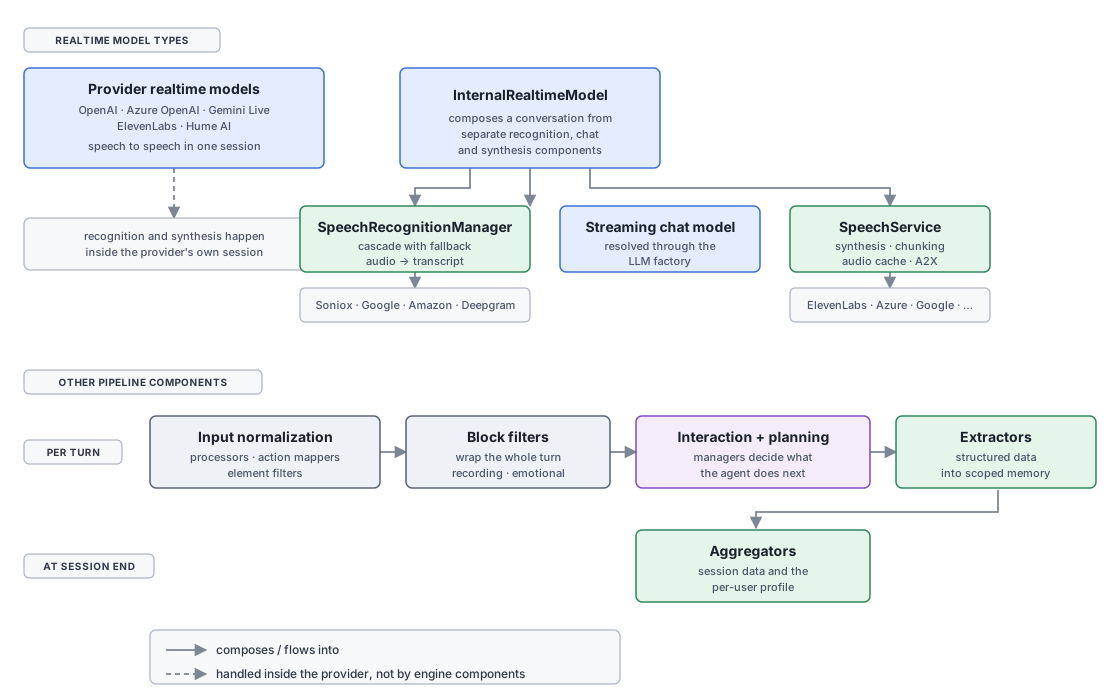
The upper half of the diagram is the distinction that matters most. A provider realtime model
receives audio and returns audio: recognition, generation and synthesis all happen inside the
provider’s own session, and the engine only feeds it elements and reads them back.
InternalRealtimeModel instead composes a conversation out of three engine components —
SpeechRecognitionManager for recognition, a streaming chat model resolved through the LLM
factory, and SpeechService for synthesis — which is what allows a realtime conversation to run
on providers that offer no speech-to-speech API, and to mix a recognizer, a language model and a
voice from different vendors.
The lower half shows the other pipeline component categories and when they run: input normalization and block filters around each turn, the interaction and planning managers deciding what the agent does, extractors turning the turn into structured memory, and — at the end of the session — aggregators. Those are catalogued in Interaction Pipeline Components.
The Contract
RealtimeModel (common/src/main/kotlin/ai/promethist/ai/RealtimeModel.kt):
interface RealtimeModel<RP : RealtimeProperties> {
    val name: String get() = this::class.simpleName!!.removeSuffix("RealtimeModel")

    fun process(
        context: RealtimeContext,
        systemPrompt: SystemPrompt,
        toolBox: ToolBox,
        canDelegate: Boolean = false,
    ): RealtimeSession<RP>
}
Two things are worth noting:
-
nameis derived from the class name by convention —OpenAIRealtimeModelisOpenAI,GeminiLiveRealtimeModelisGeminiLive,InternalRealtimeModelisInternal. This is the name matched against theproviderof the resolved properties, so a model is registered simply by being a bean. -
processis synchronous and opens nothing. It only constructs the session object; the provider connection is established lazily when the session’s element stream is first subscribed. The provider’s own properties are read from the context (context.realtimeProperties), andcanDelegateonly matters to a turnless model: it says whether the interaction manager answers the model’s delegations, see OpenAILiveRealtimeModel.
RealtimeSession
RealtimeSession (common/src/main/kotlin/ai/promethist/pipeline/RealtimeSession.kt) is the
per-conversation provider session:
abstract class RealtimeSession(val systemPrompt: SystemPrompt) : LoggingContext {
    var lastActive: Instant
    var activeDuration: Long
    abstract val realtimeProperties: RealtimeProperties
    var tokenUsage = RealtimeTokenUsage()
    protected open val whenReady: Mono<Unit>

    fun activity(): Long
    fun process(context, transcriptRecognizer, elements, toolHandler): Flux<RealtimeElement>
    fun process(instruction: RealtimeInstruction): Mono<Void>

    protected abstract fun handle(elements: Flux<Element>, toolHandler: ToolHandler): Flux<RealtimeElement>
    protected abstract fun handle(instruction: RealtimeInstruction): Mono<Void>
}| Member | Role |
|---|---|
|
Rendered once at session creation and fixed for the session’s lifetime. |
|
The provider’s own properties — read across the pipeline for |
|
Accumulated by the provider session as usage events arrive, and read at session end for the usage record. |
|
Active-time accounting for usage metering. Each gap contributes at most 30 seconds, so an idle connection does not inflate the total. |
|
Provider readiness gate. Input is held with |
What the Base Class Adds
The public process(context, transcriptRecognizer, elements, toolHandler) is the only entry point
the pipeline uses, and it wraps the provider’s handle with behaviour every provider gets for
free:
-
Speech recognition routing. When a transcript recognizer is present and
realtimeProperties.sttProvideris notNone, raw audio is split out of the input and routed throughSpeechRecognitionManager, while everything else passes through. Interim transcripts are forwarded to the client and into the model in parallel. WhensttProviderisNonethe audio goes to the provider untouched and the provider does its own recognition and turn detection. -
Transcript normalization — guarantees at least one and at most one interim transcript before the final transcripts of a turn, so client-side barge-in logic has a stable signal.
-
Turnless sentence release. A turnless model (
isTurnless) has no response to end, so no sentence window ever closes - and the sentence assembly, which looks one token ahead to tell the end of a sentence from a dot inside "14. října", holds the last token back until the next one arrives. For such a model a sentence is therefore released once its closing token (.,?or!, with trailing whitespace and closing quotes ignored) has been followed by 300 ms without a further token, instead of when the model speaks again. NoResponseEndis produced and there is no turn boundary. Only a token that closes a sentence starts the wait, so a pause in the middle of a sentence releases nothing and drops no text. A sentence that goes on after a dot more than 300 ms later - such as an ordinal at the end of a token - is split at that dot. -
Token to sentence assembly — groups streamed tokens into sentences per response window.
-
Idle response end. If the stream falls silent for 20 seconds, a synthetic
ResponseEndis injected with a warning. Turn windowing downstream is driven byResponseEnd, so this is what prevents a stalled provider from hanging a turn forever. Turnless models are excluded: they stream audio without a pause, so it would never fire. -
Error normalization. Everything leaving a session is mapped to a
RealtimeException, whether it was thrown synchronously or signalled reactively.
process(instruction) is the injection leg used by planning. It wraps the provider’s
handle(instruction) and deliberately swallows errors — a failed instruction injection must not
kill a live conversation.
Realtime Elements
Realtime elements are the internal vocabulary between a session and the pipeline. They are
translated to client-facing output elements centrally, in
Context.outputElement (common/src/main/kotlin/ai/promethist/pipeline/Functions.kt); an element
with no mapping is a programming error and fails loudly.
| Element | Meaning |
|---|---|
A user speech recognition result: |
|
A streamed response text delta. |
|
A complete response sentence, either assembled from tokens or delivered whole by providers that do not stream. |
|
A chunk of output audio with |
|
The end-of-response boundary. This is the token the whole pipeline windows on, and it reaches the
client as the |
|
Steering text injected into the model: |
|
A turnless model asking for help: an |
|
An out-of-band control or telemetry event with a name and parameters, mapped one-to-one onto a
client command. Names in use include |
|
A localized, user-presentable error that does not terminate the stream. |
|
A UI card or handover produced by a tool call. Also folded into the set of shown multimodals that planning receives. |
|
Prosody and emotion scores, rendered as visual state with |
Properties and Provider Selection
RealtimeProperties is Jackson-polymorphic on its provider property, so a stored
RealtimeConfiguration carries the provider’s own typed settings:
interface RealtimeProperties {
    val provider: String get() = this::class.simpleName!!.removeSuffix("RealtimeProperties")
    val isTurnless: Boolean get() = false
    val hasToolSupport: Boolean get() = true
    val gender: Gender?
    val sttProvider: String
    val sampleRate: Int
    val temperature: Double
}
isTurnless marks a model that speaks continuously and has no response that ends. It decides which
pipeline manager drives the conversation (see Pipeline Managers), and
today only OpenAI GPT-Live sets it. hasToolSupport is false for a model that calls no tool of its own.
sttProvider is the switch between the two operating modes described above — a provider name (for
example Soniox) routes audio through the engine’s own recognition, None leaves recognition to
the provider.
The configuration itself is resolved by RealtimeConfigurationService, which caches each lookup
for promethist.realtime-configuration.ttl-seconds (900 by default) and fails with a not-found
error for an unknown ID. Where the ID comes from depends on the setup:
-
AgentContextServiceuses the agent’srealtimeConfigurationId; -
BasicContextServiceuses the connection’srealtimeConfigurationIdparameter (or theX-Realtime-Configuration-IDheader), which is what the bridge and preview flows set.
The model is then picked by string match, in RealtimeSessionFactory:
val model = realtimeModels.firstOrNull { it.name == context.realtimeProperties.provider } as RealtimeModel<RealtimeProperties>?Providers
| Model | Behaviour |
|---|---|
OpenAI Realtime API over WebSocket. Built on |
|
OpenAI GPT-Live, a speech-to-speech model with no turns, over its own WebSocket protocol. Selected when the
|
|
The same protocol against Azure OpenAI, round-robining across the configured regions so load and quota spread over deployments. |
|
Google Gemini Live through the GenAI SDK rather than a raw socket. Configures response modality,
system instruction, voice, input and output transcription with language hints, context-window
compression and — only when |
|
ElevenLabs conversational API. The provider does its own turn detection ( |
|
Hume AI EVI. In addition to transcripts and audio it emits emotional state from prosody scores, which is what drives the visual state for this provider. |
|
The engine’s own composition — see below. |
Provider Quirks Worth Knowing
-
OpenAI and Azure sessions expire after the provider’s hard session limit; that is surfaced as a non-recoverable error with its own localized message. Two benign protocol codes (an already active response, and cancelling a response that is not active) are logged and ignored.
-
A recoverable provider error does not end the conversation: the pending input transcript is flushed, a recovery instruction ("you missed the user’s input, apologize and ask them to repeat") is injected into the model, and the error is emitted to the client.
-
Gemini Live handles the provider’s go-away by reconnecting with a stored resumption handle.
-
ElevenLabsRealtimeModeldoes not implement instruction injection, so planning instructions and per-turn context injection have no effect with that provider. -
ElevenLabs and Hume AI do not report token usage, so the usage record of those sessions carries zero tokens.
OpenAILiveRealtimeModel
OpenAILiveRealtimeModel (engine/component/OpenAILiveRealtimeModel.kt) serves OpenAI GPT-Live, which is
named OpenAILive because the provider of the OpenAI properties is OpenAILive whenever their model
starts with gpt-live. The protocol differs from the Realtime API, hence the separate component.
The model owns the spoken conversation. It speaks continuously, decides for itself when to talk, and has
no end-of-response event and no way to be told to respond — so the session synthesizes no turn boundary,
and TurnlessPipelineManager drives it, see
Turnless Conversations.
-
Connection. A WebSocket to
/v1/live/sessions(promethist.realtime.openai-live.path). The handshake must not carry anOriginheader, which Reactor Netty adds, or the API answers 403; the session removes it. -
Startup. One
session.startframe with the model, the instructions, the voice, PCM audio at the configured sample rate in both directions, and the delegation setting. Input transcription, turn detection and noise reduction are managed by the server and rejected as parameters. The session then sends 200 ms of silence, as the model ignores everything appended before it has received any input audio. -
Input is audio only. An
Actionsuch as#introis appended on the instructions channel followed by a directive to act on it now, since withoutresponse.createa vaguer wording reliably produces silence. Any other element has no channel and is dropped — aCommitincluded, as there are no turns to commit. -
Input clock. The model’s timeline — what it hears, says and reasons about — advances only as input audio arrives. A client that stops sending audio, such as a push-to-talk client between presses, would freeze the model mid-sentence, so every second without a chunk of audio is answered with a second of silence (
silentIfEmpty). -
Output is the user’s transcript, always asynchronous so it never barges the client in and emitted once the transcription has been quiet for
utteranceIdleTimeoutMs(700 ms by default); the model’s transcript as tokens, which the base session joins into sentences; and the model’s audio as speech items. Usage is reported in seconds of voice and no tokens. -
Instructions reach the model on one of three append channels, by their type:
INSTRUCTIONon the instructions channel (it may interrupt the current speech),COMMENTARYon the commentary channel (what the model speaks, paraphrasing it) andSUPPORTING_CONTEXTon the thinking channel (absorbed silently). An append overmaxAppendTokens(500 by default) is rejected, so longer text is split at sentence, line and word boundaries, and at last into windows of characters. -
Delegation. The model decides when it needs help and asks with
session.delegation.created, which carries only an id and an offset. The session fixes who answers for its whole lifetime:-
client delegation — the engine does. The delegation, carrying the text read back from the transcripts, goes to the interaction manager, and the model has no tools of its own. Used when the interaction manager is a
TurnlessDelegatingInteractionManager. -
responses delegation — GPT-Live does, by calling a Responses API backend (
delegationModel,gpt-5.1by default) configured with the context part of the system prompt and the tool box’s tools. The session only executes the function calls that backend asks for, and once all are answered continues the response withresponse.create. The session instructions, without the context, tell the model that the backend exists and when to use it; without that it answers from its own knowledge.
-
-
Errors. A rejected append (
invalid_request_error) or a transient server error costs that piece of context, not the conversation, and is reported to the client; any other error ends the session.
InternalRealtimeModel
InternalRealtimeModel (engine/component/InternalRealtimeModel.kt) satisfies the same contract
by assembling the conversation from separate parts, which is how the platform runs a realtime
conversation on providers that have no speech-to-speech API:
-
Recognition comes from the base class, because
InternalRealtimeProperties.sttProviderdefaults to a real provider — the session itself only ever sees transcripts and text. -
Generation uses a streaming chat model resolved through
SpringAiLLMFactoryfromInternalRealtimeProperties.modelConfiguration, so any configured chat provider can drive a realtime conversation. -
Synthesis streams the generated tokens into
SpeechService, which interleaves sentence text with speech items and can stream tokens directly into a token-streaming synthesizer.
Its turn loop is where barge-in is implemented explicitly: inputs are windowed on interim
transcripts and the in-flight generation is dropped when a new interim transcript arrives, with a
synthetic ResponseEnd closing the interrupted response. A final transcript starts a generation;
within a window inputs are answered sequentially.
Each response is assembled as: the echoed input as a transcript, then the speech (or plain
sentences when the connection is textOnly), then any elements produced by tool calls, then
ResponseEnd. Contextual instructions are kept as a rolling window of the last five and injected
as system messages; a non-contextual instruction is fed in as a new input, which triggers a
response.
Failures are non-recoverable and typed: an unresolvable provider, a model stream error, or a speech synthesis error.
Where the Lifecycle Is Driven From
Nothing above decides when a session starts, when turns begin and end, or when planning runs — that is the orchestrator’s job. See Realtime Conversation Lifecycle.