Platform Core
Project Overview
Promethist Core projects implements a runtime for relational AI agents. Its main part is the engine — a reactive Spring Boot application that executes a conversation inside an interaction pipeline: it recognizes speech, drives a language model with the agent’s instructions, memory and tools, synthesizes the reply and streams it back to the client in real time.
This documentation covers the platform repository: what the individual modules are, how to build and run them, how the engine is put together internally, and how a deployment is operated.
Module Structure
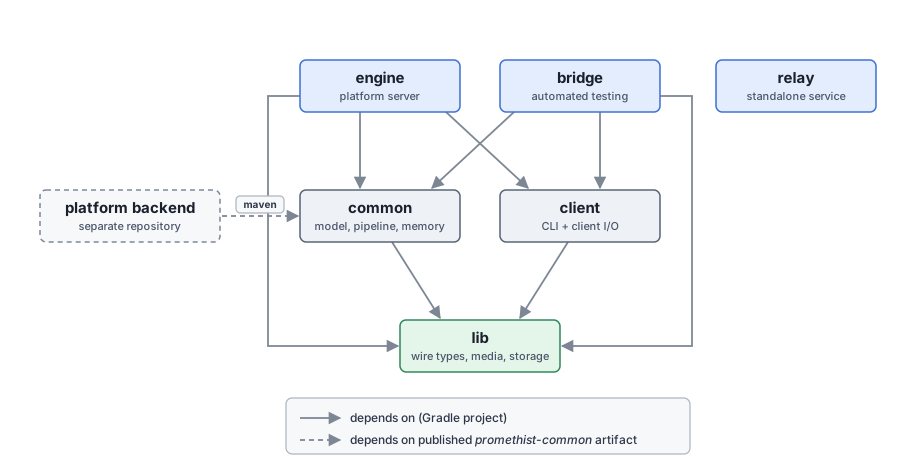
An arrow points from a module to what it depends on:
-
libis the foundation — the wire protocol types, media utilities and storage abstractions. It depends on nothing. -
commonandclientare siblings, each depending only onlib.clientdoes not depend oncommon. -
engineandbridgeare applications and depend onclient,commonandlib. -
relayis a standalone service with no module dependencies at all. -
commonis additionally published as thepromethist-commonMaven artifact, which the platform backend service in its own repository builds against — so its public types are a shared contract beyond this repository.
Modules describes each module and the build layout in detail.
Documentation Map
- Modules
-
The Gradle modules in this repository, what each is for and how they depend on each other.
- Technology Stack
-
Languages, frameworks and the external services the platform needs at runtime — with the role each of them plays.
- Development Setup
-
Prerequisites, building, running the engine locally, running tests, the local infrastructure stack and the local port map.
- Core Deployment
-
How container images are built and released, and how the core services are deployed with the Helm charts in
deploy/. - Code Conventions
-
Formatting rules and the KtLint tooling, including the pre-commit hook.
- Engine Application
-
Internal architecture of the engine: pipeline, components, services, controllers, AI layer, sockets and security.
- Common Library
-
The shared library: domain model, pipeline abstractions, memory, AI abstractions, storage and serialization.
- Bridge Application
-
The automated conversation testing service — how to run tests against real devices, browsers and virtual agents.
- Reference CLI Client
-
The command-line reference client, useful for exercising the conversation protocols by hand.
- Core Documentation
-
The official public-facing documentation of the platform core — the engine’s REST API and the conversation protocols — intended for third-party developers.
Building This Documentation
The documentation is an Antora component. Its sources live in docs/; the
site is assembled by the playbook antora-playbook.yml in the repository root:
npx antora antora-playbook.ymlThe generated site is written to build/site. API reference documentation for the Kotlin code is
generated separately with Dokka:
./gradlew dokkaHtmlMultiModule